Local News
Army Vehicle Disappears
An Australia Army vehicle worth $74,000 has gone missing after being painted with camouflage.
Case Study
SaaS
Information Modeling
Construction Visualization
Case Study
API Management
Identity Management
Open Source

Case Study
Internet Services
Telco
Broadband and ADSL

Case Study
Consumer Entertainment
Mobile Commerce
Finance

2026 (Current Focus)
Want to know more?
Let's connect


Copyright © 2026, All Rights Reserved.
Made with 💛 By Thushitha!
Loading...
Click anywhere to enter with sound
Just not this particular thing, at this particular moment.
We’re still polishing this page up. Stay tuned!
Interaction design for 3D spatial data at Xyicon
Figma
Custom Design Systems
WebGL/Three.js
Interaction Models
Client: Xyicon
Year: 2019 – 2023
Role: UX Lead
Xyicon operates at the cutting edge of asset visualization and asset relationship managemenet, helping large enterprises manage physical spaces through "Digital Twins." As the Lead UI/UX Engineer, I was responsible for translating complex spatial data and equipment locations, floor plans, and asset tracking, into an intuitive web interface. This role required me to go beyond standard UI patterns, requiring the invention of novel interaction models for 3D plotting, spatial navigation, and data layering.

Standard web apps are 2D grids (lists, cards, tables). Xyicon is spatial.
My strategy was to move away from static sidebars and embrace a "Contextual UI" approach—tools appear only when and where they are needed.
I held a workshop with an interdisciplinary team of colleagues, where I presented an early version of the pattern library. We came up with the following principles and guidelines to help us design the library and choose when to use which pattern.
It took about about one month to build and iterate on it, and eventually to code the individual components. The specifications for the library live in a PDF document.
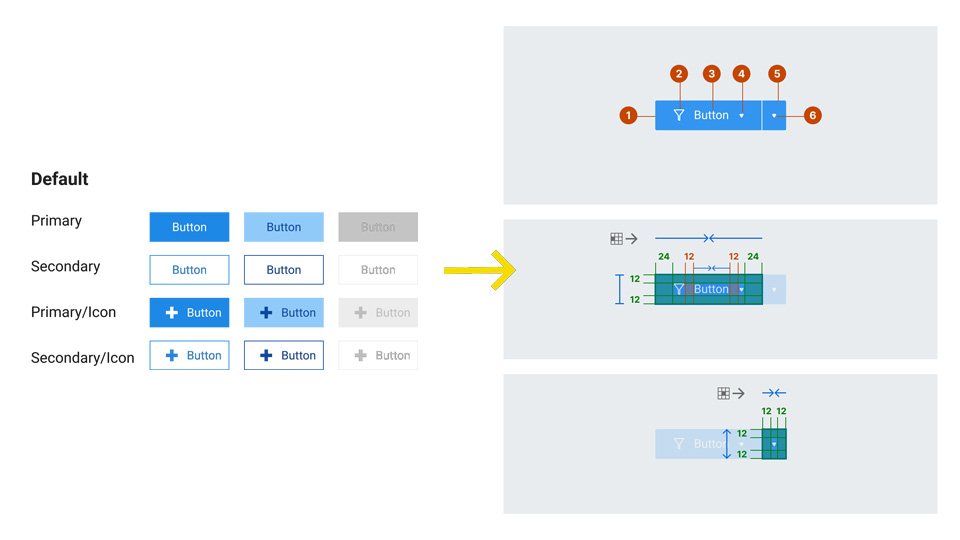
These are the smallest and most basic building blocks. Our foundations include typography, colour, spacing, and borders. Elements include buttons, links, headings, inputs, etc.
The components are created by combining basic elements – they can take on many forms like lists and cards.


The modules are created by combining basic elements and components. While we use a standard set of modules in our day to day work, new and distinct modules are always being created to suit special design needs.
Just a couple of examples of how the patterns have been used to design some of STADA's brand websites.


This common set of patterns has kept our products consistent with the STADA brand and their sub-brands. Our team learned a lot about communication and collaboration while working on our pattern library.
A living library. A design system needs constant development, maintenance and improvement. The biggest challenge has been to maintain one 'source of truth', and to keep the design library and coded components in sync. As we continuously use and expand it, we are making mistakes and learning as we go.
Designing for reusability. I learned the importance of coming up with a common language and documenting component specifications when working with a team of designers and developers. While it required a lot of work up front, having a set of patterns means we now have a smooth design, approval, build and launch process.
Local News
An Australia Army vehicle worth $74,000 has gone missing after being painted with camouflage.